






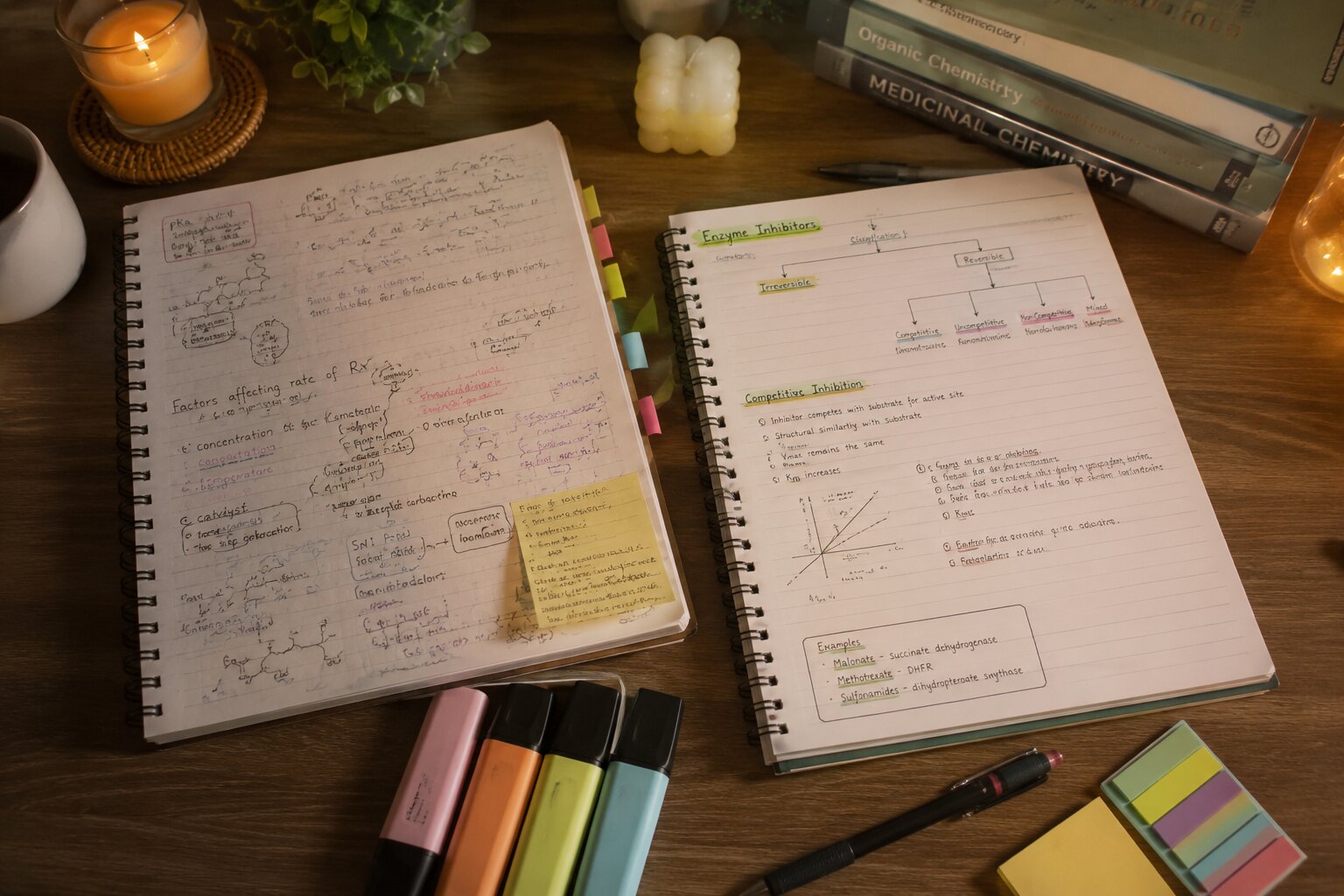
“I'll just make these notes neat first… then I'll start studying properly.”
If that sentence sounds familiar, congratulations - you've probably been trapped in the same cycle I was during my B.Pharm days.
Every semester started with big promises. I bought a brand-new notebook, a pack of colourful highlighters that I definitely didn't need, and pens that wrote smoother than my exam preparation ever did.
For the first few weeks, I felt unstoppable.
Every heading was perfectly underlined. Every diagram looked like it belonged in a textbook. My notes were so neat that my friends often asked to borrow them.
The only small problem?
I couldn't remember half of what I'd written.
Looking back, I wasn't studying - I was decorating.
Don't get me wrong, there's absolutely nothing wrong with keeping your notes organized. A clean notebook definitely makes revision easier. But somewhere along the way, I became more focused on choosing the right highlighter than asking myself whether I actually understood the topic.
At first, I thought I simply needed to spend more hours studying. But later, I came across an interesting study by Karpicke, Butler, and Roediger (2009), which explained something I had unknowingly experienced myself. The researchers describe this as an “illusion of competence” - the feeling that you've learned something simply because you've read or highlighted it several times, even though you may struggle to recall it when it matters most [1]. Reading that study made me realize that my beautiful notes weren't the problem; my study method was.
And pharmacy isn't exactly a course where you can “wing it” the night before an exam.
One day you're trying to understand acid-base titrations, the next day it's pharmacology mechanisms, medicinal chemistry structures, pharmaceutical calculations, or remembering which drug belongs to which class. The syllabus grows faster than your confidence, and suddenly those beautiful notes start looking more like artwork than study material.
That's when I realized something had to change.
Not my handwriting.
Not my notebook.
My way of studying.
After trying different methods over several semesters, I finally found a routine that genuinely worked for me. It wasn't expensive. It didn't require fancy apps or complicated planners.
It only required two notebooks.
Sounds too simple?
That's exactly what I thought.
Notebook One: Where the Mess Was Allowed
This notebook had one simple rule:
Nobody was ever going to judge it.
Seriously.
If someone opened it, they'd probably think I had been taking notes during an earthquake.
There were arrows pointing in random directions, words circled three times, questions in the margins, half-erased diagrams, and handwriting that even I struggled to read a week later.
But that's exactly why it worked.
Instead of copying textbook definitions word for word, I started writing what I actually understood.
Whenever a topic sounded too technical, I translated it into language that made sense to me.
If a pharmacology mechanism felt confusing, I imagined explaining it to my best friend in the college canteen.
If I couldn't explain it in simple words, I knew I hadn't really understood it.
Sometimes I'd even write silly examples or funny mnemonics just to make a concept stick.
This notebook wasn't meant to look good.
It was meant to make me think.
And that's a huge difference.
It became the place where I could ask stupid questions, make mistakes, draw messy diagrams, and connect different ideas without worrying about how the page looked.
Looking back, that ugly notebook taught me far more than my beautiful one ever did.
Notebook Two: The One That Saved Me During Exams
Once I actually understood a topic, only then did it earn a place in my second notebook.
Think of this notebook as the VIP section.
Not every piece of information was allowed in.
Unlike my first notebook, this one was clean, organized, and straight to the point.
No unnecessary paragraphs.
No textbook copying.
No decorative pages.
Only the information I genuinely needed before examinations.
For every topic, I usually asked myself three simple questions:
- What is the one thing I absolutely need to remember?
- What are the two or three points my professor is most likely to ask?
- If I had only five minutes before entering the exam hall, what would I revise?
Those answers became my notes.
That's it.
I stopped rewriting entire chapters because, honestly, if you're copying the whole textbook into another notebook... you might as well carry the textbook itself.
Whenever possible, I tried to finish one topic within two pages.
It forced me to remove unnecessary information and focus only on what truly mattered.
The Five-Minute Test
One habit completely changed the way I revised.
After finishing a topic, I closed every book and notebook and asked myself one simple question:
“Can I explain this without looking?”
Not like I was writing a university answer.
Just like I was explaining it to a friend.
If I could explain it clearly, I moved on.
If I couldn't...
Back to Notebook One.
No shortcuts.
That simple habit helped me identify exactly what I didn't understand instead of giving myself false confidence.
What Changed After That?
Something surprising happened.
I actually started spending less time studying.
Not because the syllabus became smaller.
But because I stopped wasting hours rewriting things I already knew.
Revision became faster.
Topics stayed in my memory longer.
Most importantly, examinations became much less stressful because I wasn't opening hundreds of pages the night before.
Instead, I had one notebook that contained exactly what I needed.
For Every Pharmacy Student Reading This
Let's be honest.
Pharmacy is not a course where last-minute studying works for very long.
One week you're memorizing drug classifications.
The next week you're drawing medicinal chemistry structures.
Then suddenly there are practical journals, viva examinations, assignments, and sessional tests waiting for you.
It can feel overwhelming.
That's why having a simple study system matters.
You don't need ten notebooks.
You don't need expensive stationery.
You don't need the latest study trend from social media.
You simply need a method that helps you understand first and revise later.
Final Thoughts
If I could go back and give my first-year self-one piece of advice, it wouldn't be,
“Study harder.”
It would be,
“Stop trying to make perfect notes. Start trying to understand imperfectly.”
Because learning is rarely neat.
It's messy.
You'll make mistakes.
You'll erase things.
You'll rewrite concepts.
And that's completely normal.
Today, whenever students ask me how to prepare for university examinations, I don't recommend the newest productivity app or another expensive planner.
I simply tell them about the method that quietly transformed my own college life.
One notebook to learn.
One notebook to revise.
It won't magically reduce your syllabus overnight.
But it will make your revision smarter, your learning deeper, and your confidence much stronger.
And who knows.
The next time someone asks to borrow your notes, you'll probably hand them Notebook Two…
…and quietly hide Notebook One before they see the beautiful chaos that made it all possible.
Reference
1. Karpicke, J. D., Butler, A. C., & Roediger III, H. L. (2009). Metacognitive strategies in student learning: Do students practise retrieval when they study on their own? Memory, 17(4), 471-479.