






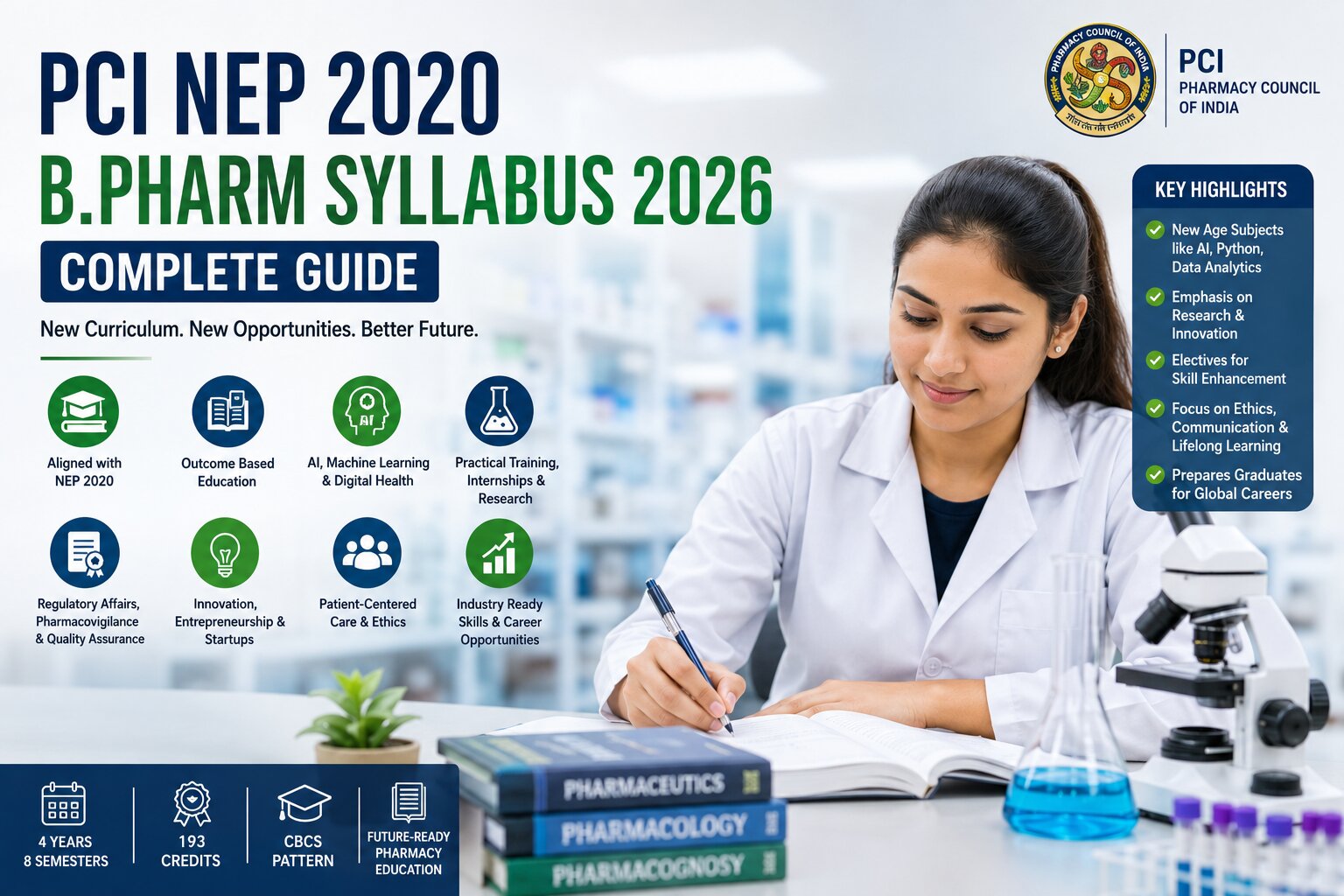
PCI B.Pharm New Syllabus
2026: Complete list of subject added under NEP 2020
The Pharmacy Council of
India (PCI) has introduced a new B.Pharm syllabus to be implemented from the
2026–27 academic session. The revised curriculum has been developed in
accordance with the National Education Policy 2020 with the objective of
producing skilled, innovative, and industry-ready pharmacy graduates. The
syllabus emphasizes competency-based education, practical learning, research,
digital technologies, and patient-centered healthcare.
Some of the major
features of the new syllabus include:
- Alignment with NEP 2020 and an
outcome-based education system.
- A 4-year, 8-semester programme with
approximately 193 credits under the Choice Based Credit System (CBCS).
- Introduction of modern subjects such
as Artificial Intelligence (AI), Python Programming, Machine Learning,
Data Analytics, and Digital Health to prepare students for future
pharmaceutical technologies.
- Greater emphasis on practical
training, laboratory work, internships, research projects, and
experiential learning.
- Inclusion of elective courses that
allow students to develop additional professional and technical skills.
- Strong focus on Regulatory Affairs,
Pharmacovigilance, Quality Assurance, Intellectual Property Rights (IPR),
entrepreneurship, ethics, and communication skills.
- Development of graduate attributes
such as critical thinking, teamwork, leadership, innovation,
professionalism, and lifelong learning.
The revised PCI B.Pharm
syllabus aims to bridge the gap between academic knowledge and industry
requirements. It prepares graduates for careers in pharmaceutical industries,
hospitals, community pharmacy, clinical research, regulatory agencies,
academia, and healthcare technology while ensuring they are equipped with the
latest scientific and digital competencies. Overall, the 2026 syllabus
represents a significant modernization of pharmacy education in India and
enhances the employability and professional capabilities of pharmacy graduates.
GRADUATE ATTRIBUTES
(GA’s) Graduate
Attributes (GAs) represent the key competencies and professional qualities
expected from every pharmacy graduate, irrespective of the program such as
D.Pharm, B.Pharm, Pharm.D or M.Pharm. While the level of mastery may vary,
these attributes remain common and guide the overall outcomes of pharmacy
education.
1. Pharmaceutical
Knowledge Proficiency – Strong grounding in core and applied pharmaceutical
sciences and practice.
2. Scientific and
Analytical Thinking – Ability to critically analyze data, processes, and
clinical information.
3. Ethical and
Professional Integrity – Commitment to ethical conduct, patient safety, and
regulatory compliance.
4. Patient-Centered
Orientation – Sensitivity to patient needs, cultural diversity, and healthcare
outcomes.
5. Industry and Practice
Readiness – Preparedness for roles in industry, hospitals, community pharmacy,
research, and regulation.
6. Digital and
Technological Awareness – Familiarity with AI, data analytics, automation, and
modern pharmaceutical technologies.
7. Effective
Communication Skills – Clear, empathetic, and professional interaction across
healthcare settings.
8. Teamwork and
Leadership Skills – Ability to collaborate, lead, and contribute constructively
in teams.
9. Innovation and
Problem-Solving Mindset – Capability to identify problems and develop
practical, evidence-based solutions.
10. Lifelong Learning
Orientation – Motivation for continuous professional development and higher
education.
PROGRAMME EDUCATIONAL
OBJECTIVES
The Bachelor of Pharmacy
(B. Pharm) programme aims to prepare graduates with strong knowledge of
pharmaceutical sciences, practical skills, professional ethics, and a
commitment to patient care and public health. The graduates of the programme
are expected to achieve the following Programme Educational Objectives (PEOs):
PEO 1: Apply fundamental
knowledge of pharmaceutical sciences to work effectively in pharmacy practice,
pharmaceutical industry, research, and related healthcare fields.
PEO 2: Demonstrate
practical skills in drug formulation, manufacturing, pharmaceutical analysis,
quality control, and pharmacy practice.
PEO 3: Use scientific
reasoning and problem-solving skills to address challenges related to
medicines, drug development, and patient care.
PEO 4: Practice pharmacy
with ethical responsibility, good communication, teamwork, and concern for
patient safety and public health.
PEO 5: Pursue continuous
learning and professional development to keep pace with advances in
pharmaceutical sciences and healthcare.
PROGRAMME OUTCOMES
(POs)
Bachelor of Pharmacy
(B. Pharm)
PO1.
Pharmacy Knowledge
Apply comprehensive
knowledge of pharmaceutical sciences, biomedical sciences, pharmacology,
pharmacognosy, pharmaceutical chemistry, pharmacy practice, and manufacturing
processes to understand drug actions, disease mechanisms, and therapeutic
interventions and solve professional problems across diverse pharmacy domains.
PO2.
Problem Analysis, Critical Thinking and Evidence-Based Decision Making
Identify, formulate,
analyze, and interpret complex pharmaceutical problems using principles of
scientific inquiry, critical thinking, biostatistics, and evidence-based
reasoning to arrive at defensible solutions and informed decision-making.
PO3.
Pharmaceutical Skills & Practice
Demonstrate proficiency
in formulation development, analysis, quality assurance, pharmacovigilance,
clinical pharmacotherapy, and pharmacy practice through laboratory work,
simulations, internships, and experiential learning.
PO4. Modern
Tools, AI & Digital Competence
Select, apply, and
evaluate modern pharmaceutical tools, analytical instruments, digital
technologies, artificial intelligence, machine learning, and computational
techniques with awareness of their limitations and ethical use.
PO5.
Research & Innovation
Design and conduct basic
research, analyze data, interpret results, and contribute to innovation through
research projects, startup initiatives, and problem-based learning relevant to
industry, healthcare, and society.
PO6.
Professional Ethics & Human Values
Apply ethical principles,
professional integrity, regulatory frameworks, intellectual property rights,
and universal human values while addressing professional, legal, and societal
responsibilities in pharmacy practice.
PO7.
Communication & Interpersonal Skills
Communicate effectively
with patients, healthcare professionals, industry personnel, and society
through clear documentation, reports, presentations, counseling, teamwork, and
interdisciplinary collaboration.
PO8.
Leadership, Management & Entrepreneurship
Demonstrate leadership,
teamwork, planning, and managerial skills in pharmaceutical organizations,
healthcare systems, quality systems, and entrepreneurial ventures, including
innovation and startup ecosystems.
PO9.
Pharmacist & Society
Evaluate public health,
patient safety, legal, and societal issues related to pharmacy practice and
contribute responsibly to healthcare delivery, rational use of medicines, and
improvement of community health outcomes.
PO10.
Environment and sustainability
Recognize and address the environmental impact
of pharmaceutical manufacturing, use, and disposal, and promote environmentally
responsible practices, green pharmacy principles, and sustainable healthcare
aligned with the United Nation’s Sustainable Development Goals (SDGs).
PO11.
Life-Long Learning & Professional Development
Recognize the need for
continuous learning and demonstrate the ability to engage in self-directed,
life-long learning to adapt to technological advancements, evolving healthcare
needs, and professional growth.
Course of study
The course of study for
B. Pharm shall include Semester wise Theory & Practical as given in Tables
– I to VIII. The number of hours allotted to each theory and practical course
in any semester shall not be less than that shown in Tables – I to VIII.
Table-I:
Course of study for semester I
|
Course
Code |
Name
of the course |
No.
of hours per week (L/P) |
Credit
points |
|
BP101T |
Basics
of Python Programming for Pharmaceutical Sciences (Theory) |
2 |
2 |
|
BP102T |
General
Pharmacy (Theory) |
3 |
3 |
|
BP103T |
Healthcare
Psychology and Communication Skills (Theory) |
1 |
1 |
|
BP104T |
Human
Anatomy, Physiology and Pathophysiology I (Theory) |
4 |
4 |
|
BP105T |
Introduction
to Pharmacognosy (Theory) |
3 |
3 |
|
BP106T |
Pharmaceutical
Inorganic and Analytical Chemistry (Theory) |
3 |
3 |
|
BP107P |
General
Pharmacy (Practical) |
3 |
1 |
|
BP108P |
Healthcare
Psychology and Communication Skills (Practical) |
2 |
1 |
|
BP109P |
Human
Anatomy, Physiology and Pathophysiology I (Practical) |
3 |
1 |
|
BP110P |
Introduction
to Pharmacognosy (Practical) |
3 |
1 |
|
BP111P |
Pharmaceutical
Inorganic and Analytical Chemistry (Practical) |
3 |
1 |
|
Total |
|
30 |
21 |
|
Course
Code |
Name
of the course |
No.
of hours per week (L/P) |
Credit
points |
|
BP201T |
Applied
Biostatistics and Data Analytics for Pharmaceutical Sciences (Theory) |
2 |
2 |
|
BP202T |
Biochemistry
(Theory) |
3 |
3 |
|
BP203T |
Human
Anatomy, Physiology and Pathophysiology II (Theory) |
4 |
4 |
|
BP204T |
Pharmaceutical
Organic Chemistry (Theory) |
4 |
4 |
|
BP205T |
Pharmacognosy
and Phytochemistry (Theory) |
4 |
4 |
|
BP206T |
Physical
Pharmaceutics (Theory) |
3 |
3 |
|
BP207P |
Biochemistry
(Practical) |
3 |
1 |
|
BP208P |
Human
Anatomy, Physiology and Pathophysiology II (Practical) |
3 |
1 |
|
BP209P |
Pharmaceutical
Organic Chemistry (Practical) |
3 |
1 |
|
BP210P |
Pharmacognosy
and Phytochemistry (Practical) |
3 |
1 |
|
BP211P |
Physical
Pharmaceutics (Practical) |
3 |
1 |
|
BP212P SEC* |
BP212P SEC
1 Communication
Skills
|
2 |
1 |
|
BP212P SEC
2 Mental
Well-Being, Stress & Conflict Management
|
|||
|
BP212P SEC
3 Fundamentals
of Computer Operations
|
|||
|
Total |
|
37 |
26 |
|
Course
Code |
Name
of the course |
No.
of hours per week (L/P) |
Credit
points |
|
BP301T |
Introduction
to Machine Learning in Pharmaceutical Sciences (Theory) |
2 |
2 |
|
BP302T |
Environmental
Sciences (Theory) |
1 |
1 |
|
BP303T |
Ethics
and Universal Human Values (Theory) |
1 |
1 |
|
BP304T |
General
Pharmacology (Theory) |
3 |
3 |
|
BP305T |
Heterocyclic
Compounds and Stereochemistry (Theory) |
3 |
3 |
|
BP306T |
Pharmaceutical
Dosage Forms I (Theory) |
3 |
3 |
|
BP307P |
Pharmaceutical
Engineering (Theory) |
3 |
3 |
|
BP308P |
Pharmaceutical
Microbiology (Theory) |
3 |
3 |
|
BP309P |
General
Pharmacology (Practical) |
4 |
2 |
|
BP310P |
Heterocyclic
Compounds and Stereochemistry (Practical) |
4 |
2 |
|
BP311P |
Pharmaceutical
Dosage Forms I (Practical) |
3 |
1 |
|
BP312P AEC* |
BP212P AEC
1 Nutraceuticals
and Functional Foods |
2 |
1 |
|
BP212P AEC
2 Food
Analysis |
|||
|
BP212P AEC
3 Yoga
and Life Sciences |
|||
|
Total |
|
32 |
25 |
|
Course
Code |
Name
of the course |
No.
of hours per week (L/P) |
Credit
points |
|
BP401T |
Herbal
Drug Technology (Theory) |
3 |
3 |
|
BP402T |
Medicinal
Chemistry (Theory) |
3 |
3 |
|
BP403T |
Pharmaceutical
Biotechnology (Theory) |
3 |
3 |
|
BP404T |
Social
Pharmacy and Public Health (Theory) |
3 |
3 |
|
BP405T |
Systemic
Pharmacology I (Theory) |
3 |
3 |
|
BP406T |
Herbal
Drug Technology (Practical) |
3 |
1 |
|
BP407P |
Medicinal
Chemistry (Practical) |
3 |
1 |
|
BP408P |
Pharmaceutical
Biotechnology (Practical) |
3 |
1 |
|
BP409P |
Social
Pharmacy and Public Health (Practical) |
2 |
1 |
|
BP410P |
Systemic
Pharmacology I (Practical) |
3 |
1 |
|
BP411I |
Internship
(Mandatory) |
8 |
4 |
|
Total |
|
28 |
23 |
|
Course
Code |
Name
of the course |
No.
of hours per week (L/P) |
Credit
points |
|
BP501T |
Biomedicinal
Chemistry (Theory) |
3 |
3 |
|
BP502T |
Industrial
Pharmacognosy (Theory) |
3 |
3 |
|
BP503T |
Innovation
and Startup Ecosystem (Theory) |
2 |
2 |
|
BP504T |
Pharmaceutical
Dosage Form II (Theory) |
2 |
2 |
|
BP505T |
Pharmaceutical
Quality Assurance (Theory) |
3 |
3 |
|
BP506T |
Systemic
Pharmacology II (Theory) |
3 |
3 |
|
BP507P |
Biomedicinal
Chemistry (Practical) |
4 |
2 |
|
BP508P |
Industrial
Pharmacognosy (Practical) |
3 |
1 |
|
BP509P |
Pharmaceutical
Dosage Form II (Practical) |
3 |
1 |
|
BP510P |
Systemic
Pharmacology II(Practical) |
4 |
2 |
|
Total |
|
30 |
22 |
|
Course
Code |
Name
of the course |
No.
of hours per week (L/P) |
Credit
points |
|
BP601T |
Advanced
Pharmacognosy (Theory) |
3 |
3 |
|
BP602T |
Biopharmaceutics
and Pharmacokinetics (Theory) |
3 |
3 |
|
BP603T |
Intellectual
Property Rights (Theory) |
2 |
2 |
|
BP604T |
AI
applications in Pharmaceutical Sciences (Theory) |
2 |
2 |
|
BP605T |
Pharmaceutical
Analysis (Theory) |
3 |
3 |
|
BP606T |
Pharmaceutical
Jurisprudence (Theory) |
3 |
3 |
|
BP607T AEC* |
BP607T AEC
1 Green
Chemistry |
4 |
2 |
|
BP607T AEC2 Materiovigilance
and Hemovigilance |
|||
|
BP607T AEC3 Scientific
Writing |
|||
|
BP607T
AEC 4 Drug
Store and Business Management |
|||
|
BP607T
AEC 5 Career
Building in Cultivation of Medicinal Plants
|
|||
|
|
BP607T
AEC 6 Active
Pharmaceutical Ingredients and Excipient Sciences
|
|
|
|
BP608P |
Biopharmaceutics
and Pharmacokinetics (Practical) |
3 |
1 |
|
BP609P |
Pharmaceutical
Analysis (Practical) |
4 |
2 |
|
BP610P SEC* |
BP610P SEC
1 Computer-Aided Drug Design |
2 |
1 |
|
BP610P SEC
2 Analytical
Method Development and Validation |
|||
|
BP610P
SEC3 Principles
of Preclinical Studies |
|||
|
BP611P VAC* |
BP611P
VAC1 Professional
Skills |
2 |
1 |
|
BP611P
VAC2 Process
Analytical Technology (PAT) and QbD in Formulation Science |
|||
|
BP612I |
Internship
(Mandatory) |
8 |
4 |
|
Total |
|
28 |
26 |
|
Course
Code |
Name
of the course |
No.
of hours per week (L/P) |
Credit
points |
|
BP701T |
Biostatistics
Research methodology (Theory) |
3 |
3 |
|
BP702T |
Cosmetics
and Cosmeceuticals (Theory) |
2 |
2 |
|
BP703T |
AI
in Clinical applications (Theory) |
2 |
2 |
|
BP704T |
Modern
Analytical Techniques (Theory) |
3 |
3 |
|
BP705T |
Pharmacovigilance
(Theory) |
3 |
3 |
|
BP706T |
Pharmacy
Practice (Theory) |
3 |
3 |
|
BP707T |
Regulatory
Affairs (Theory) |
2 |
2 |
|
BP708T AEC* |
BP708T AEC
1 Current
Good Manufacturing Practices (cGMP) |
1 |
1 |
|
BP708T Pharmaceutical
Automation |
|||
|
BP708T AEC3 Modern
Techniques in Cellular Biology |
|||
|
BP708T
AEC 4 Medical
Devices |
|||
|
BP708T
AEC 5 Transformation
of Food Waste into Medicinal Products |
|||
|
BP708T
AEC 6 Biosimilars,
Vaccines & Macromolecules |
|||
|
BP709P |
Modern
Analytical Techniques (Practical) |
3 |
1 |
|
BP710RP |
Research
Project |
|
6 |
|
Total |
|
22 |
26 |
|
Course
Code |
Name
of the course |
No.
of hours per week (L/P) |
Credit
points |
|
BP801T |
Ethical
Considerations and Translational Applications of AI in Pharmacy (Theory) |
2 |
2 |
|
BP802T |
Clinical
Pharmacotherapeutics (Theory) |
2 |
2 |
|
BP803T |
Industrial
Pharmacy and Facility Design (Theory) |
3 |
3 |
|
BP804T |
Pharmaceutical
Management (Theory) |
2 |
2 |
|
BP805T |
Sterile
Dosage Forms and Novel Drug Delivery System (Theory) |
3 |
3 |
|
BP806T AEC* |
BP806T AEC
1 Pharmaceutical
Packaging |
2 |
2 |
|
BP806T
AEC 2 Supply
Chain Management |
|||
|
BP806T AEC3 Industrial
Safety and Waste Management |
|||
|
BP806T
AEC 4 Traditional
Healing Practices of India |
|||
|
BP806T
AEC 5 Futuristic
Pharma through AR/VR: Pharma 4.0 |
|||
|
BP806T
AEC 6 Herbal
Cosmetics for Industry Perspective |
|||
|
BP807P |
Pharmaceutical
Marketing Skills (Practical) |
2 |
1 |
|
BP808P |
Sterile
Dosage Forms and Novel Drug Delivery System (Practical) |
4 |
2 |
|
BP809P VAC* |
BP809P
VAC1 Cleaning
Validation |
2 |
1 |
|
|
BP809P
VAC2 Basic
Training in Aseptic Handling Techniques |
||
|
|
BP809P
VAC3 Impurity
Profiling |
||
|
BP810RP |
Research
Project |
|
6 |
|
Total |
|
22 |
24 |
|
Semester |
Total
Credits |
|
I |
21 |
|
II |
26 |
|
III |
25 |
|
IV |
23 |
|
V |
22 |
|
VI |
26 |
|
VII |
26 |
|
VIII |
24 |
|
Grand
Total |
193 |