





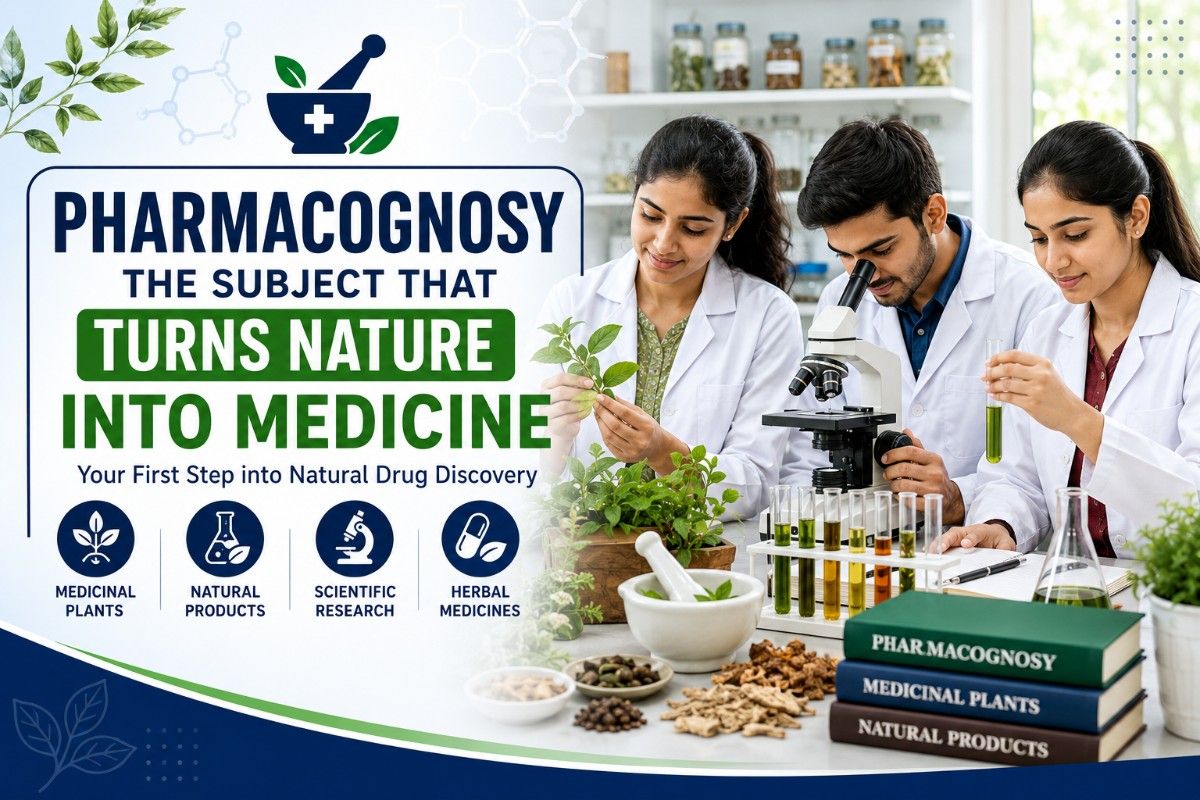
PHARMACOGNOSY
The Subject That Turns Nature Into
Medicine
A first look for every fresh 12th-pass
student about to start B. Pharm
"The next life-saving medicine may not begin in a
laboratory — it may begin in a leaf, a flower, a tree, or a microorganism
hidden deep inside a forest."
Just cleared your 12th
and picked B. Pharm? You're probably picturing chemistry labs, hospitals, and
pharmaceutical companies — and you're right. But here's something almost nobody
tells you before Day 1:
One of the very first
subjects you'll open a book on is Pharmacognosy — the science that connects
nature with modern medicine. It's the subject that quietly answers the
questions you've probably already wondered about:
•
How
did humans find medicines before laboratories even existed?
•
Why
is turmeric scientifically proven to fight inflammation?
•
How
did one tree bark — quinine — save millions from malaria?
•
Why
do researchers worldwide keep studying Ashwagandha, Tulsi, Neem, and Brahmi?
•
Could
there be tomorrow's breakthrough medicine still hiding in an unexplored forest?
If any of these made
you pause and think "huh, good question" — Pharmacognosy is about to
become one of your favourite subjects.
OUTCOMES OF THIS BLOG:

What
Exactly Is Pharmacognosy?
The name comes from two Greek roots:
|
Where the name comes from Pharmakon = Drug Gnosis = Knowledge Together: the study of medicines that come from natural
sources. |
Those natural sources aren't just
plants. They include:
• 🌿 Plants
• 🍄 Microorganisms
• 🐝 Animals
• 🌊 Marine organisms
• ⛰️ Minerals
Long before synthetic
drugs existed, civilisations across India, China, Egypt, and Greece were
already healing people with what nature provided. Pharmacognosy is modern
science going back to check that ancient homework — figuring out exactly which
compounds work, how, and how to make them safer and more consistent.
Nature
Has Already Changed Medicine Forever
A lot of students assume
"natural medicine" means "alternative medicine" — something
separate from real pharmacy. Actually, some of the most important drugs in
modern medicine came straight out of nature:
|
Medicine |
Natural
Source |
|
Morphine |
Opium poppy |
|
Quinine |
Cinchona bark |
|
Penicillin |
Fungi (mould) |
|
Aspirin |
Inspired by willow bark |
|
Taxol |
Pacific yew tree |
|
Artemisinin |
Sweet wormwood |
Each one of these has saved millions
of lives. This is exactly the world Pharmacognosy opens up for you.
More
Than Just Learning Plant Names
Here's the biggest myth about this
subject: that it's just memorising herb names. It isn't. Pharmacognosy trains
you to think like a detective and a scientist at the same time. You'll keep
asking:
• Which plant actually contains the
medicinal compound?
• Which part is useful — leaf, bark,
root, flower, or seed?
• When should it be harvested, and how
should it be stored?
• How do we know it's genuine and not
adulterated?
• How do we keep the quality consistent
every single time?
This is where science and
nature actually meet — not just where they're mentioned in the same sentence.
You'll
Learn How Medicines Grow Before They Reach Patients
Before an herb becomes a
medicine, it has to be grown, harvested, and protected responsibly. You'll
study:
• Good Agricultural and Collection
Practices (GACP) — the rulebook for growing and harvesting medicinal plants
correctly
• Sustainable farming of medicinal
crops
• Conservation of endangered herbs
• Modern biotechnology and plant tissue
culture
• Eco-pharmacognosy — protecting
biodiversity while producing medicines
As climate change and
habitat loss accelerate, pharmacists who understand this side of the subject
will have a real role to play in protecting these plants for the next
generation.
Becoming
a Medicine Detective
How does a company
actually know if an herbal medicine is genuine and not diluted or faked? This
is exactly what Pharmacognosy teaches through quality evaluation methods such
as:
• Organoleptic evaluation (appearance,
colour, smell, taste)
• Microscopy
• Chemical testing
• Biological evaluation
• DNA barcoding
•
WHO
quality standards
|
Picture this Two samples of turmeric. Same colour. Same smell. Same look. Only one actually has the correct amount of active compound. Pharmacognosy is what teaches you to tell them apart — which
is exactly why it's often called the detective science of natural medicines. |
The
Amazing Chemistry Hidden Inside Plants
Plants make thousands of
natural chemicals purely to protect themselves — and many of those same
chemicals become our medicines. You'll get introduced to compound families
like:
•
Alkaloids
•
Glycosides
•
Flavonoids
•
Terpenoids
•
Tannins
•
Volatile
oils
•
Resins,
proteins, carbohydrates, and lipids
These aren't just names
to memorise for one exam — they're the foundation you'll build on in every
advanced pharmaceutical subject that comes after this one.
Ancient
Wisdom Meets Modern Science
What makes Pharmacognosy
genuinely unique is that it refuses to throw out traditional medicine —
instead, it puts it under the microscope. You'll get an introduction to:
•
AYUSH
systems, Ayurveda, and Unani
•
Traditional
Chinese Medicine (TCM)
•
Herbal
pharmacopoeias, including the Indian Pharmacopoeia
•
WHO
herbal guidelines
Rather than accepting
age-old remedies blindly, you'll learn to test them scientifically — and that
evidence-based mindset is exactly what makes this such a modern, credible
field.
You'll
Study Herbs That Millions Already Use
Plants you've probably seen in your
own kitchen or garden become full scientific case studies — their biological
source, active compounds, and therapeutic use, all explained:
|
Herb |
Herb |
|
Ashwagandha |
Boswellia |
|
Tulsi |
Brahmi |
|
Amla |
Neem |
|
Garlic |
Giloy |
|
Arjuna |
Aloe Vera |
|
Turmeric |
Fenugreek |
|
Vasaka |
Psyllium |
|
Shatavari |
Kutki |
|
Milk Thistle |
|
You won't just know the names —
you'll understand why they work, what's actually inside them, and where they're
used in real healthcare.
Why
Pharmacognosy Matters More Than Ever
Healthcare is shifting
fast, and the world is turning toward:
• Preventive healthcare
• Herbal medicines and nutraceuticals
• Functional foods and plant-based
therapeutics
• Natural cosmetics
• Evidence-based traditional medicine
Pharmacognosy is what prepares you to
contribute responsibly to all of these growing fields, by combining hard
scientific evidence with traditional knowledge instead of picking just one.
Career Opportunities
After Learning Pharmacognosy
A common assumption is
that this subject only leads to "herbal medicine." In reality, it
opens far more doors than that:
|
Field |
What You'd
Actually Do |
|
🌿 Herbal Drug
Industry |
Develop standardised herbal medicines and phytopharmaceutical
products |
|
💊 Pharmaceutical
Research |
Discover new drug molecules from plants, fungi, marine life, and
microbes |
|
🔬 Quality
Control Labs |
Ensure herbal products are safe, authentic, and effective |
|
🧪 R&D |
Develop new formulations using natural bioactive compounds |
|
🌍 Nutraceutical
& Wellness |
Create scientifically backed supplements and preventive health
products |
|
🌱 Medicinal
Plant Cultivation |
Work with farmers and industry to improve crop quality and
sustainability |
|
📚 Higher
Education |
Specialise via M. Pharm, PhD, or international research
collaborations |
|
🌐 Regulatory
Affairs |
Help herbal medicines meet national and international quality
standards |
Skills
You'll Build Beyond the Classroom
Along the way, and often
without realising it, you'll be building:
•
Scientific
observation and critical thinking
•
Laboratory
technique and plant identification
•
Quality
assurance and research methodology
•
Evidence-based
decision making
•
A
genuine appreciation for biodiversity and sustainable healthcare
These aren't
subject-specific skills — they'll stay useful for your entire pharmacy career.
Is
Pharmacognosy Difficult?
Every new subject has a
learning curve, and this one involves botanical names, plant chemistry, and lab
methods you haven't seen before. But here's what actually works for most
students:
|
A tip that genuinely helps Don't try to memorise plant names cold. Ask "why?"
behind every medicinal plant you study instead. Why does this part of the plant matter? Why this compound, why
this use? That one habit turns rote memorisation into something that
actually sticks. |
A
Small Change in Perspective
Most people look at a
plant and see greenery. A pharmacist trained in Pharmacognosy looks at the same
plant and sees:
•
A
possible medicine
•
Centuries
of traditional knowledge
•
Fascinating
chemistry
•
Scientific
evidence waiting to be explored
•
Maybe
even the next breakthrough treatment
That
shift in how you see the world is really what this subject gives you.
Final
Thoughts
Your B. Pharm journey
isn't only about learning how medicines are manufactured or dispensed. It's
about understanding where medicines come from, how they're discovered, how
they're evaluated, and how science turns raw natural resources into safe,
effective therapies.
Pharmacognosy is your
first step into that world — so don't treat it as "just another first-year
subject."
Think of it instead as
your first step into one of humanity's oldest and most exciting pursuits:
discovering medicines hidden within nature, and using science to improve lives.
Walk
into this subject with curiosity instead of fear, and it won't just teach you
about medicinal plants — it will change the way you look at the natural world,
permanently.