






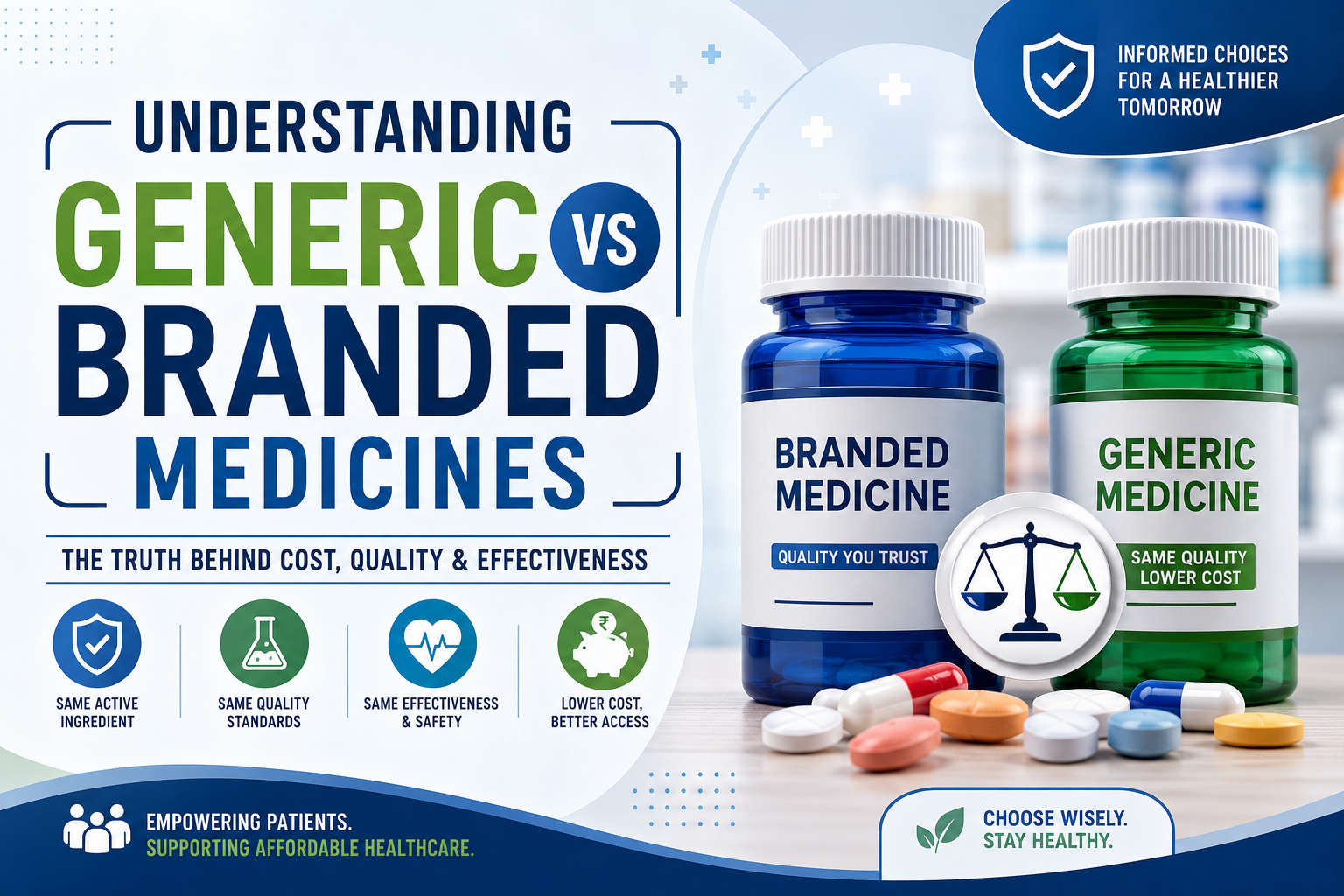
Understanding Generic vs Branded Medicines: What Every Patient
Should Know
"Is
the cheaper medicine as effective as the expensive one?"
This is one of the most
common questions patients ask at pharmacies and hospitals. Many people assume
that a higher price means better quality, while a lower-priced medicine must be
less effective. But is that really true?
Let's explore the world
of generic and branded medicines and separate myths from facts.
💊 A
Quick Challenge
Imagine you have a
headache.
Your doctor prescribes Paracetamol
500 mg.
At the pharmacy, you are
offered two options:
- Option A:
Branded Paracetamol – ₹35 for 10 tablets
- Option B:
Generic Paracetamol – ₹8 for 10 tablets
Which one would you
choose?
Think for a moment before
reading further.
What Are
Branded Medicines?
Branded medicines are
drugs sold under a trade or brand name chosen by a pharmaceutical
company.
These medicines are
usually introduced after years of research, clinical trials, and regulatory
approval. During the patent period, the company has the exclusive right to
manufacture and market the medicine.
Example
Generic Name:
Paracetamol
Brand Names:
Crocin®, Dolo 650®, Calpol®
Although the names
differ, the active ingredient remains Paracetamol.
What Are
Generic Medicines?
Generic medicines contain
the same active ingredient, same strength, same dosage form,
same route of administration, and same therapeutic effect as the
branded medicine.
They are manufactured
after the original patent expires.
Generic medicines must
meet strict quality, safety, and efficacy standards before approval.
📌 Did
You Know?
A generic medicine is
approved only after demonstrating bioequivalence with the branded
medicine.
This means it works in
the body in almost the same way as the original medicine.
Generic vs Branded Medicines
|
Feature |
Branded
Medicine |
Generic
Medicine |
|
Active
ingredient |
Same |
Same |
|
Quality standards |
High |
High |
|
Safety |
Same |
Same |
|
Effectiveness |
Same |
Same |
|
Price |
Usually,
higher |
Usually,
lower |
|
Brand name |
Yes |
Usually
sold by generic name |
Why Are
Generic Medicines Cheaper?
Many people think lower
price means lower quality.
This is not true.
Generic medicines cost
less because manufacturers:
- Do not repeat expensive clinical
trials already completed by the original manufacturer.
- Spend much less on advertising and
marketing.
- Enter a competitive market where
multiple companies manufacture the same medicine.
The lower cost mainly
reflects reduced development and promotional expenses, not inferior quality.
Myth vs
Fact
❌ Myth 1
Generic medicines are
less effective.
✅ Fact: They provide the same
therapeutic effect as branded medicines.
❌ Myth 2
Branded medicines work
faster.
✅ Fact: Both release the same active
ingredient according to approved standards.
❌ Myth 3
Generic medicines are
unsafe.
✅ Fact: They must comply with
regulatory quality standards before reaching patients.
❌ Myth 4
Doctors never prescribe
generic medicines.
✅ Fact: Many healthcare
professionals encourage generic prescribing whenever appropriate.
Why Does
Medicine Appearance Differ?
Patients often notice
that generic medicines may have:
- Different colour
- Different shape
- Different packaging
- Different tablet markings
These differences are
acceptable.
What matters is the active
ingredient, strength, quality, and therapeutic performance,
not the appearance.
Advantages
of Generic Medicines
1.
Affordable healthcare
2.
Improved patient access
3.
Better treatment adherence
4.
Reduced healthcare expenditure
5.
Wider availability of essential medicines
Are Branded
Medicines Ever Preferred?
Yes, in certain
situations.
Examples include:
- Medicines with complex drug delivery
systems
- Biological medicines (biosimilars
have separate regulatory pathways)
- Situations where a healthcare
professional recommends a specific product based on patient needs
Patients should always
follow the advice of their doctor or pharmacist.
Interactive Quiz Time
Question 1
Which statement is
correct?
A. Generic medicines
contain different active ingredients.
B. Generic medicines are
always less effective.
C. Generic medicines
contain the same active ingredient as branded medicines.
D. Generic medicines are
illegal.
Correct Answer: C
Generic medicines contain
the same active ingredient and provide equivalent therapeutic benefits.
Question 2
Why are generic medicines
usually less expensive?
A. Lower quality
B. Smaller tablets
C. Lower research and
marketing costs
D. They contain less
medicine
Correct Answer: C
The reduced cost mainly
results from lower research duplication and marketing expenses.
Question 3
True or False?
Changing the colour or
shape of a tablet automatically changes how well it works.
False
Appearance may vary, but
approved generic medicines must meet regulatory standards for quality and
performance.
Real-Life Scenario
Riya visits a pharmacy
with a prescription for an antibiotic.
The pharmacist informs
her that a generic version is available at almost half the price.
She wonders whether it
will work as well as the branded one.
What would you advise?
If the generic medicine is approved and
recommended by the healthcare professional, it is expected to provide the same
therapeutic benefit while reducing treatment costs.
Key Takeaways
- Generic medicines contain the same
active ingredient as branded medicines.
- They meet approved standards for
quality, safety, and effectiveness.
- Lower prices are mainly due to
reduced research duplication and marketing costs.
- Appearance may differ, but
therapeutic performance should remain equivalent.
- Patients should always consult a
qualified healthcare professional before changing medicines.
Final Thought
Medicines should be
chosen based on quality, safety, effectiveness, and professional medical
advice, not simply on price or brand name. Understanding the difference
between generic and branded medicines empowers patients to make informed
healthcare decisions while supporting affordable access to essential
treatments.
Have you ever chosen a
generic medicine instead of a branded one? Share your experience or discuss it
with your healthcare provider to learn more about safe and cost-effective
medication use.